

The biggest lie in synthetic yarn procurement is that a technical data sheet (TDS) tells you everything about the yarn. You can order a 0.15mm polyester mono filament yarn that looks perfect on paper, but the moment it hits your looms, you find the tenacity fluctuates across a single bobbin or the elongation at break is inconsistent. Finding reliable polyester mono filament yarn suppliers isn’t about finding someone who can hit a spec, it’s about finding someone whose process prevents that spec from drifting during a 10 ton production run.
Most buyers focus on price per kilo, which is a mistake. The real cost of a cheap supplier shows up in your waste rates and machine downtime. When the diameter varies by even a few microns, your tension settings go out the window, and you start seeing breaks that stop your entire line. A reliable partner doesn’t just ship product: they manage the polymerization and drawing process with enough precision that your floor manager doesn’t have to babysit the machines.
The hidden markers of quality in polyester mono filament yarn suppliers
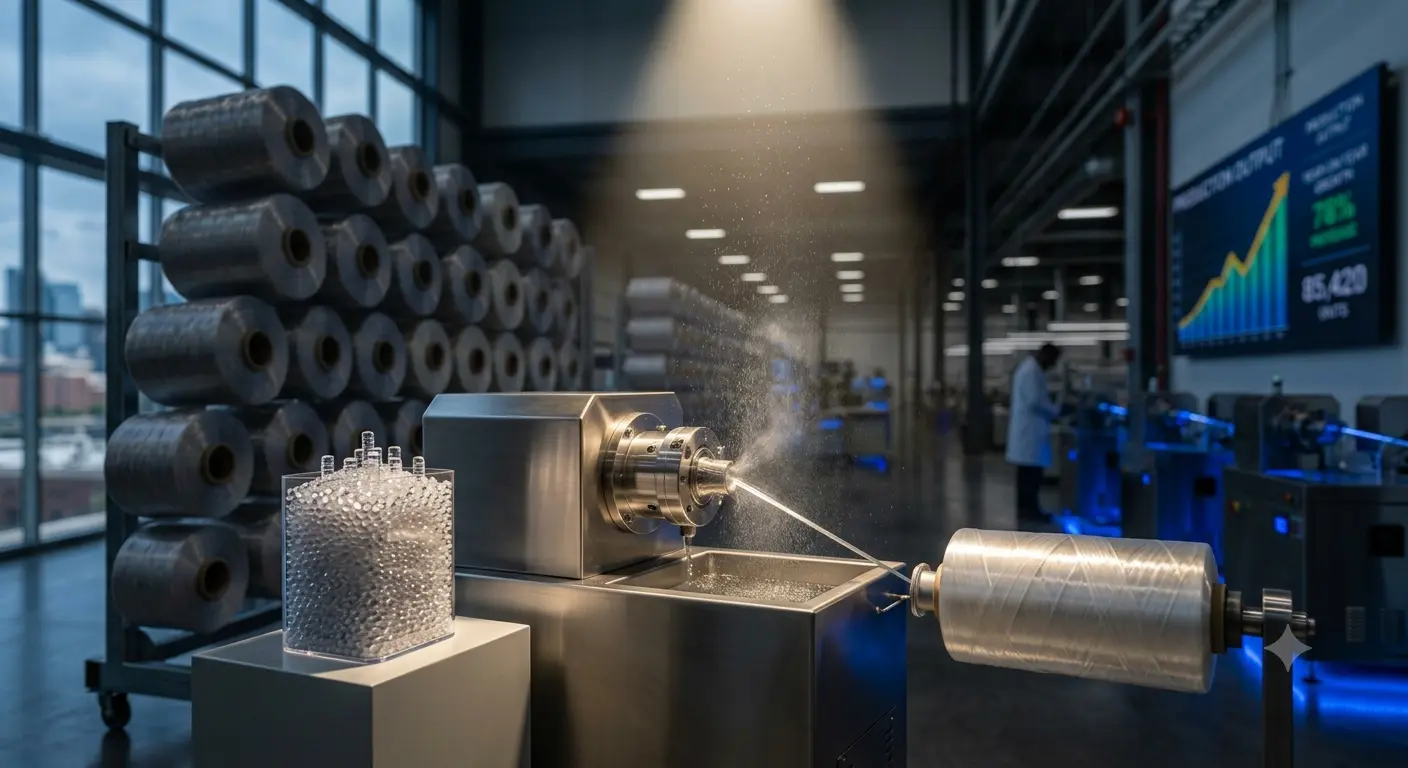
If you want to know if a supplier is actually capable or just good at sales, look at their extrusion setup. The quality of a monofilament depends on the quench rate and the draw ratio. If they are using outdated quench tanks or inconsistent cooling air, you will get internal stresses in the fiber. This leads to shrinkage issues when the yarn is exposed to heat during subsequent processing or garment finishing.
Ask about their denier control. A supplier who can’t explain how they monitor diameter in real-time is a risk. You want to hear about laser micrometers and automated feedback loops. If they tell you they check a few samples at the end of the batch, they aren’t managing the process: they are just gambling that it stayed consistent. This lack of control is why some shipments feel “stiff” while others feel “soft” despite having the same listed specifications.
Another red flag is a lack of transparency regarding the raw PET chips they use. There is a massive difference between virgin polyester and recycled blends in terms of molecular weight distribution. If a supplier is swapping chip sources to save a few cents, your breaking strength will vary from lot to lot. You need a supplier who guarantees the resin grade to ensure the crystallinity of the yarn remains stable.
Paperwork matters just as much as the process floor. A supplier’s certifications tell you whether their quality claims are independently verified or just marketing copy. Look for ISO 9001 as a baseline for documented process control, and if the yarn feeds into apparel or medical applications, ask for current OEKO-TEX and REACH compliance paperwork, not an expired certificate from three years ago. A supplier who can produce these documents on request, along with batch-specific test reports from an accredited lab, is treating compliance as part of production rather than a box to tick for new customers.
Is a lower price actually a risk to your loom efficiency?
Yes, because the “savings” are usually found in the drawing stage. To speed up production, some factories reduce the drawing time or use lower temperatures, which results in poor molecular orientation. You might not notice this in a hand-pull test, but under the constant stress of high-speed weaving, these fibers fail prematurely. You end up spending more on labor to fix breaks than you saved on the raw material.
Furthermore, cheap suppliers often neglect the finish or sizing agent applied to the yarn. The finish is what allows the yarn to slide through the guides without generating excessive friction heat. Poorly applied finish leads to static buildup and “fly” in the factory, which contaminates the fabric and increases the reject rate. When evaluating a partner, ask for the specific type of spin finish they use and why they chose it for your specific application.
Can you trust a supplier who only offers standard diameters?
It’s a sign of a commodity mindset. While standard sizes are fine for basic needs, a high-tier manufacturer should be able to tweak the draw ratio to give you a specific modulus. If they can’t discuss how they can adjust the stretch or stiffness to suit your specific machinery, they are just a middleman or a low-end mill. You want a technical partner who understands how the yarn interacts with your custom yarn specifications.
The difference between a vendor and a partner is that a vendor sells you a product that meets a spec, while a partner ensures that the product doesn’t break your process.
Evaluating the logistics and consistency loop
Consistency isn’t just about the yarn: it’s about the packaging and winding. I’ve seen perfectly good yarn ruined because the winding tension was too high, causing the filament to “neck” or deform on the bobbin. When you pull that yarn off the spool, it has permanent deformations that cause uneven tension in the weave. A reliable supplier uses precision winding to ensure the yarn remains relaxed.
You also need to look at their lot traceability. If you find a defect in a shipment of 50,000 meters, can the supplier tell you exactly which extruder produced it and what the temperature logs were for that shift? If their answer is “we’ll check the warehouse,” they have no real quality management system. Traceability is the only way to prevent a one-time mistake from becoming a recurring nightmare.
Shipping is another friction point. Monofilaments are sensitive to compression and UV exposure if they aren’t wrapped correctly. If the pallets arrive with crushed corners or the shrink-wrap is flimsy, the yarn can develop “flat spots” that cause snags. A professional operation treats the packaging as part of the product quality, not an afterthought.
How do you handle the “sample vs. bulk” discrepancy?
This is a classic industry pain point. The sample is produced on a slow, carefully monitored line, but the bulk order is rushed through. To stop this, demand a pre-shipment sample (PSS) taken directly from the actual production lot, not a separate “golden sample” created for approval. Use a tenacity tester on the PSS and compare it to the original sample. If there is more than a 3% variance, stop the shipment.
You should also establish a tolerance agreement in writing. Don’t accept “standard industry tolerances” because those are often too broad for high-precision work. Define exactly what is acceptable for diameter variance (e.g., +/- 0.01mm) and weight consistency. When the boundaries are clear, the supplier is more likely to maintain the rigor needed to meet them.
Before committing to a full container order, run a pilot batch through your actual production line rather than relying on lab results alone. A few hundred kilos processed on your looms will surface issues that a tenacity tester in a controlled lab never will, things like how the yarn behaves at your specific line speed, humidity, and tension settings. Treat this pilot run as a checkpoint, not a formality: compare defect rates, downtime, and reject percentages against your current supplier before scaling the order up. Suppliers confident in their process rarely hesitate to support a pilot run, since it’s free proof of the consistency they’re claiming.
Is it better to source from a specialist or a general yarn mill?
Specialists usually have better extrusion dies and a deeper understanding of polymer rheology. General mills often treat monofilament as a side project, using the same equipment they use for multifilament yarn. This is a problem because monofilament requires different cooling profiles and tension controls. A specialist understands the physics of a single thick strand versus a bundle of thin ones, which means fewer defects like voids or bubbles in the filament.
If you are producing high-performance gear, medical textiles, or industrial filters, the specialist is the only way to go. For basic garment reinforcement, a general mill might suffice, but you are still taking a risk on the batch-to-batch stability. It’s always worth checking their quality control standards to see if they have dedicated lines for mono production.
The financial reality of yarn procurement
Don’t get blinded by the “per kilo” price. Calculate the total cost of ownership. This includes the cost of the yarn, the cost of the waste generated by breaks, the cost of machine downtime, and the cost of potential customer returns. A supplier who is 5% more expensive but reduces your waste by 2% is actually the cheaper option.
Furthermore, look at their payment terms and lead times. A supplier who is always “at capacity” and pushes your delivery dates back by two weeks is a liability. In the textile world, a delay in raw materials can kill a seasonal contract. You need a partner with buffer capacity and a realistic production schedule. If they promise a 10-day turnaround on a complex custom order, be skeptical: they are likely cutting corners on the cooling or drawing process to hit the date.
Lastly, evaluate their technical support. When a lot doesn’t run well, do they send a technician to your plant to help adjust the tension, or do they just tell you to “adjust your machines”? A reliable partner takes ownership of the yarn’s performance in your specific environment. This level of support is what separates the top manufacturing partners from the basic traders.
Selecting the right partner comes down to verifying the process, not just the product. Focus on the extrusion controls, the draw ratio stability, and the traceability of the PET resin. If a supplier avoids these technical questions, they aren’t the right fit for a professional production line.
If you are tired of inconsistent batches and machine downtime, it’s time to move to a partner who prioritizes process stability over bottom-line pricing. Get in touch with the experts at polyester mono filament yarn suppliers who understand the physics of the fiber.
Contact Jkorin today for a technical consultation on your yarn requirements.
Frequently asked questions
What is the most common cause of yarn breakage in monofilaments?
The most common cause is inconsistent diameter or internal stress caused by improper quenching during extrusion, which creates weak points that snap under tension.
How does the draw ratio affect the strength of the yarn?
A higher draw ratio generally increases tenacity and modulus by aligning the polymer chains, but too much draw can make the yarn brittle and prone to snapping.
Can polyester monofilament be dyed after extrusion?
Yes, but it is difficult due to the dense structure. Most high-quality suppliers use masterbatch dyeing during extrusion for uniform, deep color saturation.
What is the difference between virgin and recycled PET monofilament?
Virgin PET offers higher consistency in tenacity and purity, while recycled PET may have slight variations in strength and color due to the source material.
How should monofilament yarn be stored to prevent degradation?
It should be stored in a cool, dry environment away from direct sunlight and heavy pressure to prevent the filaments from flattening or losing elasticity.